

For a while, recovery seemed straightforward. Daily tasks had returned close to normal. Typing was more consistent, buttons still took effort but could be managed, and both hands worked together to put on shoes the way they always had. There was enough function to believe the improvement would continue.
By late July, the pattern began to change. More typing mistakes appeared on the computer screen, buttons took longer, and familiar movements required more concentration. My hand was weaker, and fine motor control, the small movements used for tasks such as typing, fastening buttons, and handling small objects, had begun to decline again.
Putting on shoes showed the loss of function more clearly than almost anything else. The task has always required both hands because of my spastic diplegia. One hand helps position and control my leg while the other grips, opens, and pulls the shoe into place. The movement also requires enough control to work against spasticity while keeping my balance.
Once my left hand weakened, that sequence no longer worked. I could not pull my leg into position, counter the resistance from spasticity, hold the shoe open, and guide my foot into it with one hand doing most of the work. The problem was not that putting on shoes took longer. The combination of weakness, reduced finger control, and the physical demands of spasticity meant I could no longer complete the task the way I had before.
By then, the changes were affecting more than one task, and the questions were getting harder to set aside. Typing errors could be corrected, and buttons took more time and concentration. Shoes were different because the task depended on both of my hands working together.
By August, the loss of function had reached a point where I had to act and make decisions about what came next. Calls were made, referrals were requested, and appointments were scheduled. With each appointment came another explanation of how my hand had weakened and which tasks had become more difficult. The hope was that someone would recognize what was happening or offer an explanation that connected the changes. The harder part was getting access to the people who might be able to answer those questions at all.
Searching for the right doctors and therapists also meant learning enough to identify the questions that needed answers. The first seemed simple: why would my hand become weaker after surgery intended to relieve pressure on the ulnar nerve? In an ulnar nerve transposition, the nerve is moved from its usual position behind the elbow to a new position intended to reduce pressure and stretching.
The research did not offer a single explanation for why function might continue to decline after surgery. One possibility was that a nerve already significantly compromised before surgery could recover slowly or incompletely. Persistent or recurrent symptoms can also have other causes. These may include continued compression, scar tissue around the nerve, problems with how the nerve moves in its new position, or another condition contributing to the symptoms. None of these possibilities provided an answer. They did, however, offer a place to begin looking for one (Burahee et al., 2021).
The order of the symptoms raised another question. Numbness had first appeared in the little finger and part of the ring finger before weakness became obvious. The ulnar nerve supplies sensation to those fingers and motor function to several muscles involved in grip, pinch, and finger coordination. Sensory changes can appear before more obvious motor loss. By the time typing, buttons, and shoes were becoming difficult, the problem was affecting the small coordinated movements needed for those tasks (Burahee et al., 2021).
Knowing that made the sequence more understandable, even though it did not explain why the damage had occurred. It also led to more questions. Where had the nerve been injured, and what had the nerve conduction testing shown about the severity of the damage?
Was the nerve recovering as expected? If strength continued to decline, did that point to slow recovery, continued compression, scar tissue, another problem, or something no one had yet considered? Answering those questions requires a physician who can interpret the testing, the surgery, the examination findings, and the pattern of symptoms together.
Therapy raised a different set of questions. The problem was not simply a low grip-strength number. Grip strength is commonly measured with a hand dynamometer, which records how much force the hand can produce when squeezing. The number can help document weakness and compare one hand with the other, but it does not show how well the fingers coordinate, how the hand manages a complex task, or how weakness affects function outside the therapy room.
Typing required enough finger coordination to keep the hands working accurately. Buttons required control. Putting on shoes required both hands to work together. Ulnar nerve dysfunction can weaken the intrinsic muscles, the small muscles within the hand that help control finger movement, pinch, grip, and coordination. That made the loss of function easier to understand but did not make treatment simple (Burahee et al., 2021).
From my perspective, therapy had to be tied to what was actually being lost. The questions needed to be more specific: which muscles were weak, how much strength and control remained, and what those muscles could safely be asked to do at this stage of recovery. Treatment might involve strength, coordination, task practice, adaptation, protection of the nerve, or some combination of those approaches, but the choice should follow from what the examination showed.
Occupational therapy research emphasizes improving function through the activities a person needs to perform. Repetitive exercise may have a role, but it is not the only measure of progress (Cahill, 2021). A higher number on a strength test does not necessarily mean that function has improved. The change matters when it carries over into everyday tasks. For me, that meant being better able to dress, type, handle objects, and use both hands together.
Shoes made that distinction especially clear. Putting them on requires more than finger strength. The task depends on both hands, leg positioning, balance, and enough control to work against spasticity while the shoe is opened and pulled into place. A therapy plan focused only on grip strength would miss the way the task actually happens and the reason the loss of hand function has such a large effect.
Cerebral palsy makes the question more complicated. My spastic diplegia affects my legs more significantly, but balance does not depend on my legs alone. My hands and arms carry more of the physical demand. They grip the walking poles, steady me, and help me compensate when my balance is less reliable.
Years of repeated gripping, sustained arm positioning, and reliance on the hands and arms for balance may have placed additional stress on the ulnar nerve. The research, however, does not allow a cause-and-effect relationship to be established between those demands and the nerve damage. Repetitive pressure and prolonged elbow positioning are recognized sources of ulnar nerve stress. Persistent or recurrent symptoms after surgery can also be associated with scar tissue, recurrent compression, or new areas where the nerve becomes irritated (Burahee et al., 2021).
The connection to cerebral palsy is less clear. In one small study of 29 people with spastic cerebral palsy who had significant changes in how their limbs moved or were positioned, 11 had signs of one or more compressed nerves. The researchers suggested that muscle tightness, limited joint movement, contractures, which are lasting tightening of muscles or other tissues that restrict how far a joint can move, and changes in limb position could place extra pressure or strain on nerves in certain areas of the body (Frascarelli et al., 2005).
The people in that study were different from me, and the study does not prove that cerebral palsy or any one feature of it caused my ulnar nerve damage. It does suggest that the combined effects of muscle tightness, restricted movement, body mechanics, and long-term physical compensation could be relevant when considering why a nerve may become stressed or injured.
Because I rely on my arms and hands for balance when walking, reducing how much I use them can also affect my mobility and stability. If repeated gripping or arm position may be contributing to nerve stress, the answer cannot simply be to grip less. The better question is whether the poles, grip, elbow or wrist position, or the amount of force through my arms can be adjusted without making walking less stable.
The same approach should guide conversations with doctors and therapists. The discussion should identify what has changed from my usual function, whether those changes are expected, and what may be causing them. It should also consider whether another diagnosis, spasticity, compensation, or use of mobility supports could be contributing. From there, the focus should be on what activities remain safe, what should be modified, and when further medical evaluation is needed.
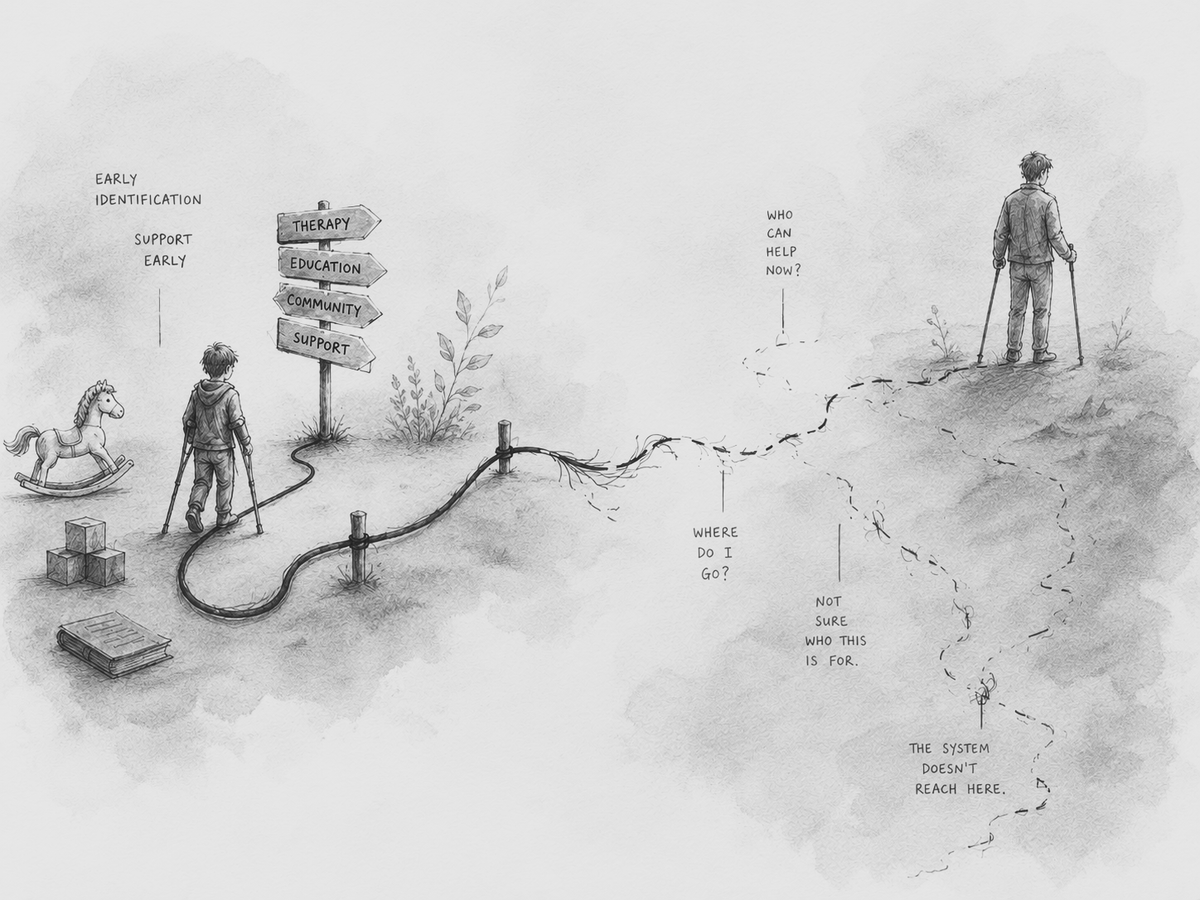
The questions are basic, but they become more important when different parts of the body and different diagnoses intersect. A surgeon may understand the nerve. A therapist may understand hand function. Someone with neurological rehabilitation experience may understand spasticity and compensation. What I have been trying to find is care that does not require those pieces to exist separately.
Research has helped me ask better questions. It has also shown me more clearly where the answers stop. Studies can explain possible causes of weakness after surgery and why numbness may appear before obvious muscle weakness. They can identify the functions commonly affected by ulnar nerve damage and suggest that body mechanics and repeated strain may matter. What research cannot tell me is which explanation applies to me.
The unanswered questions also began reaching backward. Was there an earlier sign I had not recognized? Had years of compensating for balance played a role? Would finding it sooner have changed the outcome? Hindsight has an unfair advantage. It judges an earlier decision with information that only became available later.
A symptom recognized in August can make something from May look obvious in retrospect. A decision that seemed reasonable at the time can look different once the outcome is known. New information can sharpen an old question without proving that the answer should have been available sooner.
Uncertainty made it tempting to search for a single cause. If one mistake could be identified, the story might be traced back to one decision and perhaps corrected. The research made that kind of certainty harder to justify. Persistent or recurring symptoms after ulnar nerve surgery can have several causes, and sorting among them requires clinical evaluation rather than conclusions drawn from one symptom or one difficult task (Burahee et al., 2021).
There are choices I would approach differently now because I know more, and questions I would ask sooner. Neither means an earlier decision caused what happened. Some questions about responsibility can be examined. Others remain unanswered because the evidence is not there.
The uncertainty also challenged another assumption. For most of my life, belief and action have existed together. Trust has meant making the call, asking the question, preparing, advocating, and continuing. Somewhere along the way, responsibility had started to feel like a promise that enough effort would eventually produce an answer.
My hopes were specific. I wanted my hand to improve. I wanted clinicians who could consider the nerve injury alongside cerebral palsy, mobility, and compensation. I wanted to understand why my function had declined and what might help restore it. Wanting those things made sense. Accepting that effort could not guarantee them was harder.
The uncertainty has also changed what can reasonably be expected from the search for care. An appropriate referral may still lead nowhere, and a future visit may provide useful information without fully explaining the decline. One clinician may understand nerve surgery without understanding spasticity, while another may understand disability without having the expertise to evaluate postoperative nerve function. Better questions may improve the conversation, but they cannot guarantee access or certainty.
Expectations of the medical process have changed under those conditions. It is easier to keep moving forward when there is a clear direction and some reason to think continued effort will lead to an answer. It is harder when function has been lost and the right expertise has not yet been found. The hand still needs medical care, and those answers require the right clinical expertise.
The changes are easiest to see in ordinary tasks. Typing, fastening buttons, and putting on shoes show what the hand can manage on a given day. A better day does not prove recovery, and a harder one does not predict what will happen next. The changes matter, but none can explain the whole picture on its own.
By late August, the hand is still weak. Putting on shoes is still difficult because the left hand cannot do what it once did. There are still appointments to pursue and questions to ask. What is causing the weakness? Is the nerve recovering? What can therapy safely address? How should spasticity, balance, and reliance on walking poles be considered as part of treatment? When is further evaluation needed?
Some answers may become clearer. Others may not. The hope for improvement remains, but uncertainty does not need to be replaced by an explanation before the evidence supports one.
Tomorrow there will still be words to type, buttons to fasten, and shoes to put on. Those tasks will continue to show what has changed. The answers are still uncertain. The changes are not.
References
- Burahee, A. S., Sanders, A. D., & Power, D. M. (2021). The management of failed cubital tunnel decompression. EFORT Open Reviews, 6(9), 735–742. https://doi.org/10.1302/2058-5241.6.200135
- Cahill, S. (2021, May 12). Research update: Purposeful activities and upper extremity motor performance, sleep disturbance and hand function, and more. American Occupational Therapy Association.
- Frascarelli, M., Frascarelli, F., Gentile, M. G., Serrao, M., De Santis, F., Pierelli, F., & Santilli, V. (2005). Entrapment neuropathy in patients with spastic cerebral palsy. Acta Neurologica Scandinavica, 112(3), 178–182. https://doi.org/10.1111/j.1600-0404.2005.00468.x


Join the conversation. Your thoughts and experiences are welcome.