
People with lifelong disabilities need healthcare that recognizes when a disability is relevant to a medical concern without allowing that disability to become the explanation for every new symptom. Cerebral palsy illustrates why medical education must prepare physicians for disability-informed care across the lifespan.
Disability Must Inform Care Without Defining It
Physicians across many specialties provide care to people with disabilities. Patients may seek treatment for conditions directly related to a disability, but they also require preventive care and evaluation of health concerns that may be entirely unrelated. Medical education should prepare clinicians to distinguish between these situations.
Clinicians need to understand when a disability may be relevant to a patient’s symptoms and when other possible causes should be investigated. They must also be prepared to adapt examinations, diagnostic procedures, and communication methods when necessary to ensure appropriate and effective care.
Physicians are not always prepared to meet the needs of the full range of patients they will encounter. A clinician may understand the diagnosis recorded in a patient’s chart but have limited experience with accessible medical equipment, modified examination techniques, or alternative methods of communication. They may also lack the knowledge needed to evaluate how a lifelong disability could affect, or be affected by, a new medical condition.
This can create two different problems in clinical care. A disability may be overlooked when it should inform how a patient is examined, evaluated, or treated. In other cases, new symptoms may be attributed to the disability without adequate consideration of other possible causes, which can delay an accurate diagnosis and appropriate treatment.
Cerebral palsy illustrates this problem clearly. Published estimates indicate that approximately two to three of every 1,000 children have cerebral palsy, although prevalence varies by location and research method. A similarly reliable prevalence rate is not available for adults because national surveillance has historically focused on children.
The Cerebral Palsy Foundation’s Cerebral Palsy Grows Up initiative estimates that more than 700,000 adults in the United States are living with cerebral palsy. This population is substantial and continues to increase as more people with cerebral palsy live well into adulthood. Despite this, research, coordinated services, and clinical expertise remain disproportionately concentrated in pediatric care.
Cerebral palsy is classified according to its primary effect on movement. Spastic cerebral palsy, the most prevalent form, involves increased muscle tone and stiffness. Dyskinetic cerebral palsy involves movements that may be involuntary or difficult to control. Ataxic cerebral palsy primarily affects balance and coordination, while mixed cerebral palsy includes features of more than one movement type.
My experience is with spastic diplegia, a form of spastic cerebral palsy that affects the legs more significantly than the arms. In my case, increased muscle tone causes tightness in my calves and hamstrings, limits movement in my ankles, and contributes to a walking pattern in which my feet may drag. I use walking poles for additional support and balance.
That is only one presentation of spastic diplegia. Mobility can vary widely from person to person. Some people walk independently, while others use crutches, walkers, wheelchairs, or a combination of mobility supports depending on the activity, environment, and individual needs.
Cerebral palsy is caused by a nonprogressive neurological injury, but that does not mean its functional effects remain unchanged. As people with cerebral palsy age, physical tasks may require more effort, and activities that were once manageable may become more difficult. Changes in strength, endurance, pain, joint mobility, and the cumulative demands placed on the body can all affect function over time.
Clinical care should recognize cerebral palsy as an important part of a person’s medical and functional history while also considering whether new symptoms may have another cause. Cerebral palsy should inform clinical reasoning without becoming the default explanation for every new concern. This is a broader issue that extends beyond cerebral palsy. Medical education can help physicians better understand how disability may affect care. This includes knowledge about communication, examination, treatment, access to care, and changes in health over time.
For a person with cerebral palsy, spasticity may affect positioning during an examination or the way certain tests are performed. Changes in speech or motor control may require more time or a different approach to communication so that the patient can fully describe symptoms and concerns. New symptoms, such as weakness, numbness, or pain, should also be evaluated on their own rather than automatically attributed to cerebral palsy.
These examples point to a broader need for disability-informed care in adulthood. People with disabilities need clinicians who understand the underlying condition. They also need clinicians who recognize that new medical conditions, injuries, and age-related changes can occur alongside it. Cerebral palsy illustrates why both forms of knowledge matter, especially when adult specialty expertise is limited.
Cerebral Palsy Care Remains Centered on Childhood
Earlier identification has become an important focus in cerebral palsy care. Clinicians now have better tools to recognize signs of cerebral palsy sooner, including standardized movement assessments, neurological examinations, and imaging. An earlier diagnosis can also allow support to begin during critical stages of development. Therapy, communication supports, positioning strategies, and appropriate equipment can then be introduced based on a child’s individual needs. The goal is not simply to begin services sooner, but to support development and participation before avoidable barriers become more firmly established.
Technology is also broadening how movement can be observed and evaluated. Recorded video can allow clinicians to assess an infant’s movement when access to a specialty center is limited. Wearable devices can collect movement data over longer periods and outside the clinical setting. This may provide information that is not captured during a single examination.
Robotics and electrical stimulation may support repeated practice of specific movements. Virtual rehabilitation can use motion tracking, screen-based reaching tasks, balance exercises, or other interactive activities to guide movement and provide immediate feedback. These approaches may allow rehabilitation to be adjusted based on a person’s performance and progress.
These tools can provide useful information about movement and function. They do not capture every factor that may influence what a person is able to do. A device may record how often a movement occurs or how consistently it is completed. It may not show how pain, fatigue, the environment, or the demands of a task affected that movement. Technology can support assessment and treatment, but it cannot replace communication, clinical judgment, or an understanding of the person’s goals.
Spasticity management has also become more individualized. Treatment may include physical therapy, occupational therapy, orthotics, oral medications, botulinum toxin injections, or intrathecal baclofen. The value of each approach depends on how it affects comfort, function, energy use, health, and participation for the individual.
Muscle tone is the natural tension in muscles that helps support posture and movement. In cerebral palsy, that tension may be higher than normal and can make movement more difficult, but reducing it is not always the only goal. For some people, lower tone may improve comfort and make movement easier. For others, some of that tone may help with standing, transferring, balancing, or walking. Treatment needs to consider how a person currently moves, which muscles are contributing to function, and what may change when that movement pattern is altered.
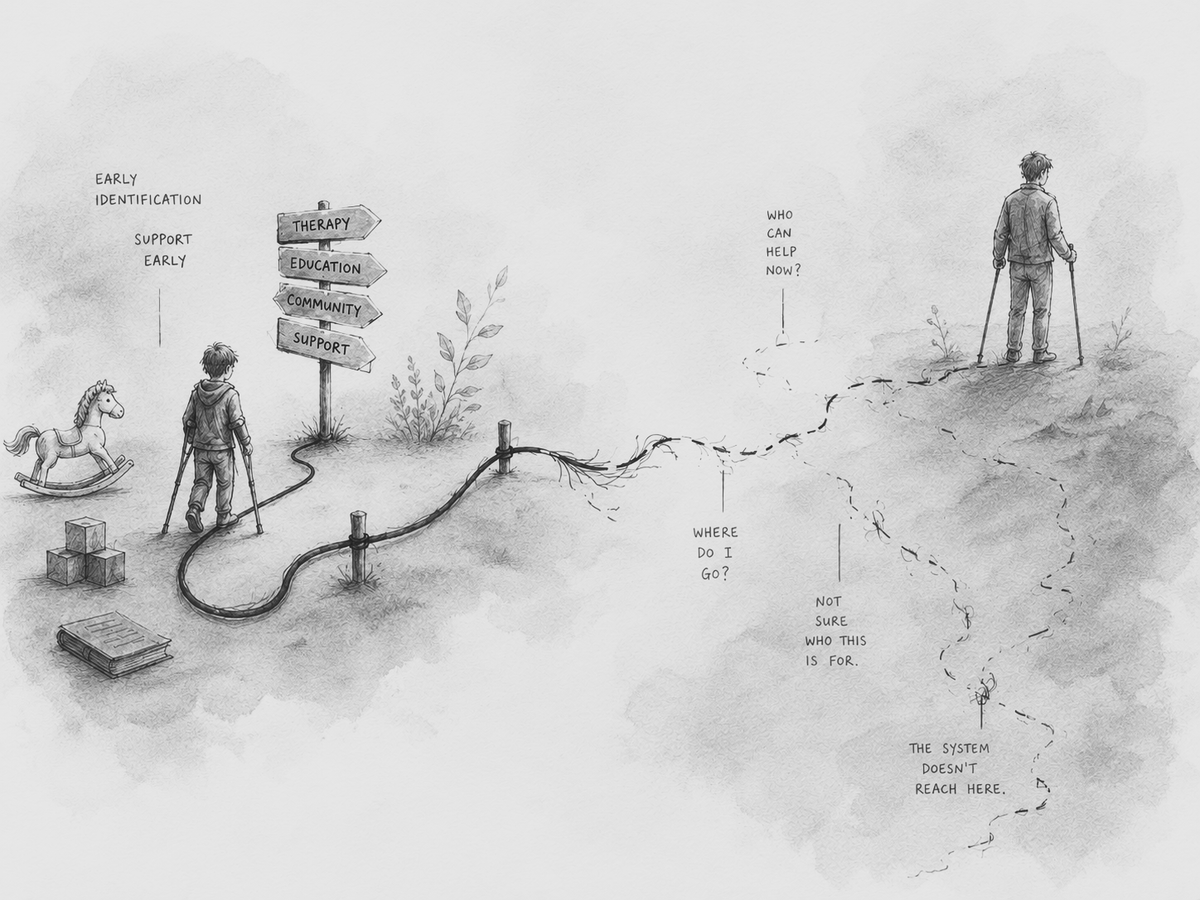
For children, this type of care is often organized within a more coordinated and recognizable system. Medical care may involve specialists who address different aspects of development, mobility, communication, and overall health. Therapy and other supports may also be provided as the child’s needs change over time.
Support often extends beyond the medical setting. Schools may provide therapy, assistive technology, transportation, communication supports, and classroom accommodations. Families may also rely on community programs, disability services, and other resources that help children participate more fully at home and in their communities.
Access to these supports is not the same for every child. Where a family lives and the resources available in the local community can significantly affect the type and consistency of care a child receives. Financial circumstances, insurance coverage, transportation, language access, and the capacity of local schools can create additional differences in access.
Even with these variations, children with cerebral palsy are generally served within systems that recognize the diagnosis and its potential impact across multiple areas of development. Pediatric care, education, rehabilitation, and related services are structured, at least in part, to address developmental, functional, educational, and medical needs over time.
In adulthood, much of this structure falls away. Care becomes less coordinated, and responsibility for understanding how cerebral palsy may affect new medical problems often shifts to clinicians who have had limited exposure to adult disability care. As a result, cerebral palsy may appear in the medical record without being meaningfully incorporated into clinical decision-making.
Medical Education Has Not Kept Pace
The transition from pediatric to adult care often changes how cerebral palsy is understood in a clinical setting. The diagnosis may remain prominent in the medical record, but its relevance to a new medical problem is not always considered in a meaningful way.
Pain, weakness, a joint condition, or a nerve injury may instead be evaluated as an isolated issue. This can overlook how spasticity, longstanding movement patterns, energy demands, or the use of mobility supports may influence the condition itself, its functional impact, and the response to treatment.
The opposite can also happen. A new symptom may be linked to cerebral palsy before other potential causes have been fully explored. That creates a different kind of risk. Cerebral palsy may be overlooked when it is relevant to understanding the problem, or it may be used too quickly to explain symptoms that warrant further investigation. Both can limit the clinical evaluation. Important contributing factors, or even an unrelated condition, may then be missed.
This variation points to a broader area of concern in medical education. Medical schools are not subject to a uniform national requirement specifying how much disability-focused clinical instruction students must receive. There is also no dependable national benchmark for measuring the amount of training physicians receive in caring for people with disabilities. Instead, disability-related content may be incorporated throughout the medical curriculum. Students may encounter these issues in pediatrics, neurology, rehabilitation medicine, primary care, psychiatry, orthopedics, and other clinical specialties.
This approach can produce substantial differences in training. One medical school may provide significant exposure to disability-related care, while another may address the subject more narrowly or primarily within individual specialties. The depth of instruction, the clinical context in which it is presented, and the opportunities for students to work directly with patients with disabilities can vary considerably among medical schools and residency programs.
As a result, completion of medical training does not necessarily indicate that a physician has received extensive practical preparation in disability-specific care. The physician’s specialty, clinical experience, residency and fellowship training, patient population, and individual areas of practice may all influence the level of knowledge and experience they bring to the care of people with disabilities.
Research on disability education shows substantial variation in how physicians are prepared to care for people with disabilities. A 2023 study examined the incorporation of disability competencies into medical training at fourteen medical schools. Because the sample was limited, the findings cannot be generalized to all programs. Within the participating schools, however, the scope and depth of disability education differed considerably, and students often had limited opportunities to learn directly from people with disabilities. The researchers concluded that disability education should be integrated throughout medical training instead of relying on a single faculty member, course, or educational activity (Lee et al., 2023).
General disability education and knowledge of a specific condition are closely related, but one does not substitute for the other. A physician may understand accessible communication and still have little preparation for evaluating how spasticity interacts with pain, fatigue, surgery, nerve conditions, medication, or changes in mobility. Conversely, a physician may understand the neurological characteristics of cerebral palsy yet have limited experience adapting an examination, assessing functional changes, or discussing treatment with a patient whose movement or communication differs from customary clinical expectations.
These concerns extend well beyond cerebral palsy. Medical training may provide limited practical instruction on examining a patient who cannot transfer to a standard examination table, communicating with someone who uses an augmentative communication device, or completing preventive screening when accessible equipment is required. Familiarity with a diagnosis, by itself, does not ensure that a physician has the practical skills needed to provide accessible and individualized care.
The consequences are often most apparent during medical appointments. Patients with disabilities may need to explain why a standard examination position is not possible, describe how they communicate most effectively, or identify ways a proposed treatment could affect mobility, self-care, employment, and participation in daily life. Their knowledge of their own bodies and lived experience is an important part of clinical decision-making. It should inform professional judgment, not serve as a substitute for the training clinicians should already have.
Adult Care Requires Lifespan Knowledge
The transition from pediatric to adult care often exposes the consequences of limited training in adult cerebral palsy. During childhood, care may be coordinated across rehabilitation, orthopedics, primary care, therapy, and equipment needs. That structure frequently becomes less organized in adulthood.
An adult may see one clinician for primary care, another for pain, another for orthopedic concerns, and someone else for rehabilitation or equipment. Those providers may work in different health systems and use separate medical records. They may never communicate directly or develop a shared plan.
Much of the coordination then falls to the patient. Records have to be collected. Medical histories are repeated. Recommendations may need to be compared or reconciled, and unresolved questions are carried from one appointment to the next. Even a referral can lead nowhere when the clinicians listed do not treat adults with cerebral palsy, are not accepting new patients, or focus on only one part of a more complicated clinical picture.
Recent research has documented similar concerns from the perspectives of adults with cerebral palsy and service providers. In a 2025 study conducted in Ireland, service providers reported that specific workplace training on supporting adults with cerebral palsy was not available to them. Some relied on previous experience working with children, information from colleagues, or online resources.
The study does not show that every healthcare system functions this way. It does, however, demonstrate the problems that can arise when knowledge of adult cerebral palsy is acquired informally rather than treated as a routine part of professional preparation (Manikandan et al., 2025).
The effects are not limited to finding appropriate specialists. Gaps in knowledge can also shape how changes in health or function are interpreted. New pain, fatigue, weakness, swelling, or difficulty completing a familiar task may signal a condition that requires separate evaluation.
Cerebral palsy may affect how symptoms appear, how they interact with existing impairments, or how treatment should be planned. It should not become the automatic explanation for every new problem. A meaningful change from a person’s usual level of function still warrants investigation.
Barriers can also arise from the way healthcare is designed and delivered. A patient may not be able to transfer safely onto an examination table, use a standard scale, position correctly for imaging, or communicate in the way a particular system expects.
Those barriers should not determine the quality of the assessment. When the usual method does not work, the clinician must adapt the examination or find another way to obtain the necessary information. Otherwise, a limitation in the healthcare setting can become a limitation in understanding the patient’s medical problem.
These challenges become especially important as people with cerebral palsy move from pediatric to adult healthcare. Healthcare transition is not simply a matter of aging out of one system and entering another. It requires the transfer of knowledge, continuity of care, and access to adult clinicians who understand how cerebral palsy may affect health over time.
Adults with cerebral palsy do not need pediatric care extended indefinitely. They need adult healthcare informed by an understanding of cerebral palsy across the lifespan.
A More Disability-Informed Approach to Healthcare
Clinicians across all specialties should be prepared to provide accessible care. Examinations should be adapted to meet the needs of the patient, with communication and informed consent approached in ways that are clear and effective. Preventive care should receive the same attention to access and quality. Clinicians must also recognize when a new symptom or medical concern requires separate evaluation rather than assuming it is part of an existing disability.
The lack of reliable prevalence data on adults with cerebral palsy is closely connected to the shortage of appropriate adult services. Each problem makes the other harder to solve. When a population is not consistently counted, its needs are easier to overlook. The consequences extend into research priorities, clinical education, the availability of appropriately trained providers, and healthcare policy. More than 700,000 adults with cerebral palsy should not have to depend on scattered expertise or the chance of finding a clinician who happens to understand their condition.
Progress in cerebral palsy care cannot be measured only by the quality of care provided during childhood. It must also be judged by what happens as those children become adults and continue to need knowledgeable, coordinated medical care. Adult patients should be able to find clinicians who understand cerebral palsy, evaluate new symptoms on their own merits, and communicate across specialties when multiple conditions intersect. Just as important, the person receiving care should be heard, respected, and treated as an active participant in decisions about their health.
Training is one important part of improving healthcare for people with disabilities. Accessible equipment, better data, stronger coordination, and expanded adult services are also essential. These improvements are most effective when healthcare professionals have the knowledge and preparation needed to provide appropriate disability-informed care.
People with disabilities age, develop new health conditions, and experience changes that cannot always be explained by the diagnosis already documented in their medical record. For adults with cerebral palsy, effective care depends on clinicians who can understand when the disability is relevant, when it may influence a new condition, and when a different explanation needs to be considered.
Improving healthcare for people with disabilities includes making disability knowledge a more consistent part of medical education, clinical practice, and care across the lifespan. Clinicians need the preparation to view disability as one part of a person’s overall health without allowing it to define every new symptom or concern.
When people with disabilities must repeatedly explain how their disability, changing health, and medical needs intersect, it points to a broader gap in how well the healthcare system is prepared to understand and respond to them.
References
- Cerebral Palsy Foundation. Cerebral Palsy Grows Up: Adult Healthcare Initiative.
- Lee, D., Pollack, S. W., Mroz, T., Frogner, B. K., & Skillman, S. M. (2023). Disability competency training in medical education. Medical Education Online, 28(1), Article 2207773.
- Manikandan, M., Kerr, C., Fortune, J., Walsh, M., Ryan, J., & Walsh, A. (2025). Experiences of health services for adults with cerebral palsy, their support people, and service providers. Developmental Medicine & Child Neurology, 67(2), 235-244.
- McIntyre, S., Goldsmith, S., Webb, A., Ehlinger, V., Hollung, S. J., McConnell, K., Arnaud, C., Smithers-Sheedy, H., Oskoui, M., Khandaker, G., & Himmelmann, K. (2022). Global prevalence of cerebral palsy: A systematic analysis. Developmental Medicine & Child Neurology, 64(12), 1494-1506.


Join the conversation. Your thoughts and experiences are welcome.