

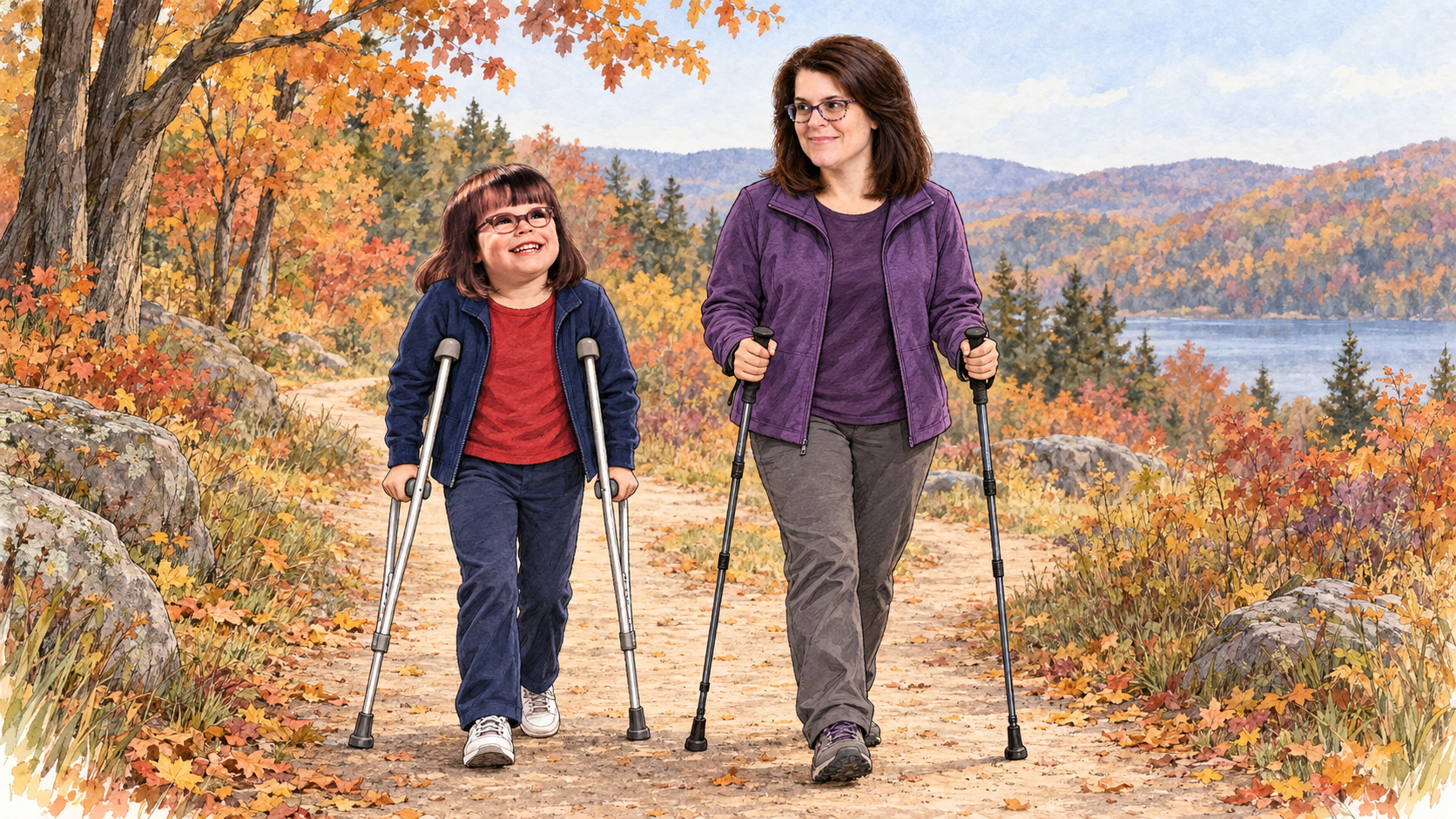
When someone notices my walking poles, what have they learned about me, and what story have they already begun to imagine? A visible disability can draw attention before a conversation begins.
Someone may notice a walking device or wheelchair. A limb difference, a speech difference, or the way a person moves through a room may also stand out. That observation is often treated as understanding. It does not explain what caused the disability, what may be difficult in a particular setting, what support may be useful, or what the person wishes to discuss.
I encounter that distinction whenever someone notices my walking poles and asks for an explanation. What often follows is a request for the story the initial observation did not reveal.
The questions may sound casual: What happened? Was there an accident? Will it get better? Each one places the same choice before me: how much of my private history I am willing to make public simply because my disability is visible.
Kathleen Bogart examines that decision in “Why People With Visible Disability Still Have to ‘Come Out.’” The article draws on interviews with 25 people with observable disabilities, including mobility disabilities, blindness, limb differences, deafness, and speech disorders.
The researchers use the term “observable disability.” I use “visible disability” here because it is more familiar, while recognizing that what is observable varies by person and setting.
People in the study still had to decide what to disclose, how much to say, and whether declining to answer would affect their access, the service they received, or how they were treated. Visibility did not reveal the cause of a disability, its consequences, access needs, or what it meant to the person (Bogart et al., 2026).
Seeing a disability is not the same as understanding the experience of living with it. A walking device may be used because of pain, fatigue, balance, weakness, distance, or several factors at once. A wheelchair may reveal something about mobility while saying little about strength, independence, or whether assistance is wanted. A speech difference can be heard, but it does not reveal the best way to continue the conversation.
What has actually been learned through observation? Often, what people notice is simply that someone moves, communicates, or participates differently. What that difference reflects is not always apparent.
Others may wonder whether the condition is temporary, whether assistance would be helpful, or whether a particular task is difficult. They may also assume that visibility makes questions appropriate or welcome.
One study participant used a leg brace and walking device because of cancer. Because others assumed that he had suffered a temporary injury, they often asked what had happened. The question called for an ordinary explanation, such as a fall or surgery, but an honest answer required him to disclose his cancer in what had begun as a casual conversation (Bogart, 2026).
The person asking may not have considered what an answer to the question would require. “What happened?” takes only a moment to ask, but answering may involve disclosing private information about illness, treatment, trauma, or an uncertain prognosis.
The person being questioned must then decide whether to correct the assumption, provide only part of the explanation, decline to answer, or allow the misunderstanding to remain. Each option can carry its own discomfort.
Asking is not inherently wrong, but context matters. The person who asks may not recognize that a seemingly casual question creates an immediate decision about disclosure. My experience also suggests that responses to visible disability are shaped by a person’s prior exposure, awareness, and sensitivity..
Someone who has spent time with people with disabilities may understand that assistance should not be assumed. Someone with less exposure may be uncertain about what to say or do.
That uncertainty may not come from poor intent, but it can still leave the person with a disability deciding whether to explain.
Questions about cause, duration, or change may follow. Was the disability present at birth? Was there an accident? Is it permanent? Is it improving? Could the same thing happen to someone else? Kathleen Bogart’s article and the related study suggest that the question “What happened?” may reflect more than simple curiosity.
The person asking may be trying to determine whether the disability resulted from an accident, an illness, or something they believe could have been prevented. They may also be assessing their own likelihood of having a similar experience. In this way, the question can make disability seem less personally relevant to the person asking (Bogart, 2026; Bogart et al., 2026).
Disclosure rarely stops at naming a condition. A diagnosis may prompt questions about treatment, followed by questions about recovery or improvement. A visible difference may also invite unsolicited advice about exercise, surgery, medication, therapy, or other interventions.
People with both observable and nonobservable disabilities may be asked to explain their diagnosis, how it occurred, what the future may hold, and what accommodations or assistance they need (Bogart et al., 2026). Questions about disability can reflect an assumption that the condition is expected to change, improve, or respond to treatment. They may pressure a person to explain what has been tried and whether more can be done.
At what point does concern become more intrusive than the conversation requires? The purpose of the conversation should determine how much information is needed. A physician may require a medical history, while a service provider or event organizer may need only the information necessary to provide access.
A step-free entrance does not always require an explanation of why stairs are difficult. Extra time may not require a description of symptoms. Another communication format may not require a diagnosis.
The conversation becomes personal when it moves beyond what is needed and begins asking about duration, permanence, or treatment. Its purpose should determine not only what questions are asked, but also where those questions end.
The research distinguishes between autonomous disclosure and compelled disclosure. Autonomous disclosure occurs when a person chooses to discuss disability to explain an experience, correct an assumption, build trust, or request access.
Compelled disclosure occurs when a person feels they have little real choice but to disclose because remaining silent could delay access, prevent a service from being provided, or affect how a request is understood.
People reported better outcomes when they could decide whether, when, and how to disclose a disability (Bogart et al., 2026). The fact that someone answers does not mean the choice was free of pressure. What would have happened if the answer had been withheld? Would the need still have been addressed? Would the boundary have been respected?
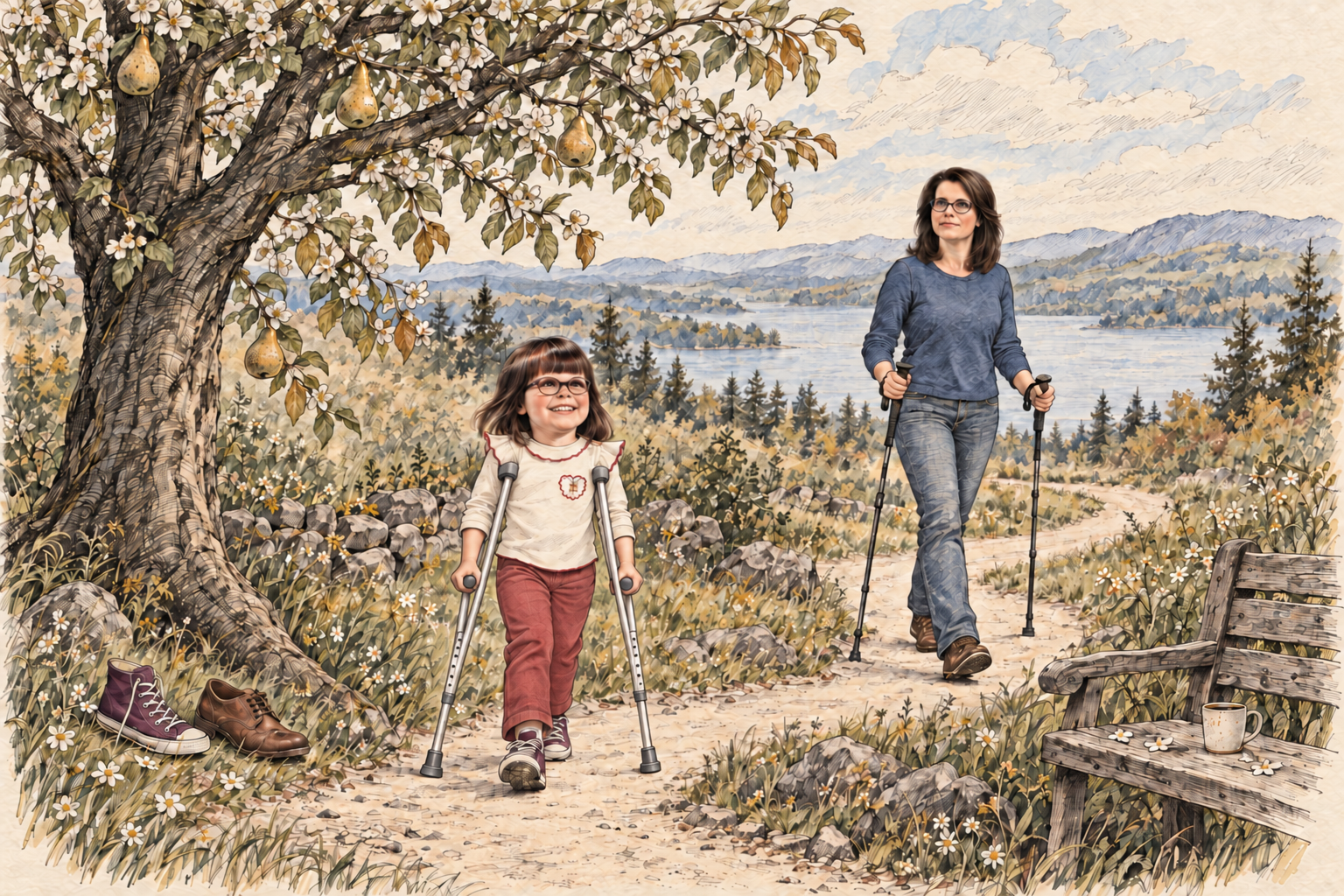
In my case, visibility is not a choice. My disability and walking poles are visible before I say anything. What I choose is whether to explain what others have noticed and how much to share. Most of the time, I choose disclosure.
I answer questions, even when the timing is not ideal, because the exchange may offer a chance to dispel a myth, provide context, or improve awareness. A question about my walking poles can become a discussion about why assistance should be offered rather than assumed. A question about access can lead to a broader consideration of how the environment shapes participation.
That openness is part of the reason I founded Wiley’s Walk.
Sharing experience can make an assumption easier to recognize and give someone a reason to reconsider what they understand about disability, independence, access, or support.
It does not make every question appropriate, and it does not always change a point of view. It is the choice I usually make after my disability has already been seen.
Sometimes the exchange leads where it was intended. Someone may reconsider an assumption or approach a future interaction with more awareness. At other times, the medical detail becomes the focus and the larger question is lost.
A discussion of access can become a story about perseverance. A description of a barrier may lead to praise for overcoming it rather than a question about why it existed. Intent can provide context, but it cannot tell the whole story.
Someone may have meant well or asked from genuine curiosity. Still, those explanations can obscure what the experience felt like and why it mattered. A person can choose what to share, but not what others take from it. A story may challenge one person’s beliefs and leave another unchanged. Telling it creates the possibility of connection without controlling the response.
Openness has limits. Writing publicly about disability does not make every detail available for discussion or every question deserving of an answer. Disclosure is a personal choice.
A person with a visible disability may want privacy, lack the energy to explain, or simply want a moment without becoming the subject of inquiry. One person’s openness should never become another person’s obligation.
A personal essay also differs from an unexpected question in a hallway, store, or meeting. Writing allows time to decide what belongs in the story and how to tell it. An unexpected question demands an immediate decision.
When disability is apparent, others may assume the subject is open for discussion, even though the person did not introduce it. A brief answer may invite another question. Declining may be mistaken for embarrassment. Even setting a boundary can create pressure to explain it.The information a person needs to disclose often depends on the setting.
A person may require assistance with one task but not another, and pain or fatigue may vary from day to day. A familiar route may be manageable, while an unfamiliar one demands advance planning. An online meeting may be accessible even when the in-person version is not.
This connection between setting and access helps explain why participants frequently disclosed information to secure access. A person with a mobility disability may not need to raise access concerns online but may need to disclose before entering a physical space.
When information about entrances, elevators, seating, and distance is unavailable, disclosure may become a condition of participation. The need to disclose, then, does not come from disability alone. It may also be produced by the environment.
An accessible entrance may be poorly marked. A meeting invitation may include directions, parking, and an agenda but leave out access details. A service may promise accommodations while requiring broad medical information at the outset.
Missing building information becomes a reason to disclose a mobility disability. An inflexible process becomes a reason to describe symptoms. Responsibility shifts away from the setting and onto the person attempting to use it. The question is not only why people disclose disability-related information, but why environments so often require them to.
Clearer information would not eliminate the need for disclosure. Disabilities vary, access needs can change, and no general description can anticipate every circumstance. It could, however, reduce the number of times people must reveal personal information simply to determine whether a place, event, or service is accessible.
Organizations can support that goal by providing advance information about entrances, elevators, restrooms, seating, captions, and remote participation. Service providers can also focus on the barrier and requested adjustment rather than asking for a personal history. This reduces the pressure to disclose a disability in order to obtain access.
When disclosure does occur, its effect remains uncertain. A personal story may challenge an assumption, encourage understanding, provide useful context, or make no visible difference. Its possible value, however, does not make it automatically available to others.
Before asking someone to share details about their disbility and circumstances, a more important question should come first:
Is this story mine to ask for, or theirs to offer?
A story offered freely can create understanding. A story expected or required changes the nature of the exchange. The difference lies in who decides whether it will be told.
References
- Bogart, K. R. (2026, July 16). Why people with visible disability still have to “come out.” Psychology Today.
- Bogart, K. R., Krauter, M. A., Cipollina, R., Wang, K., Sykes, M., Garrison, S. M., & Harcourt, D. (2026). “It’s harder to set boundaries when it’s so obvious”: Disclosing observable disabilities. Stigma and Health. Advance online publication. https://doi.org/10.1037/sah0000701
Join the conversation. Your thoughts and experiences are welcome.