

Some changes are hard to pinpoint. A once-enjoyed activity may quietly fall away without much thought. A familiar place might feel different, even though nothing obvious has changed.
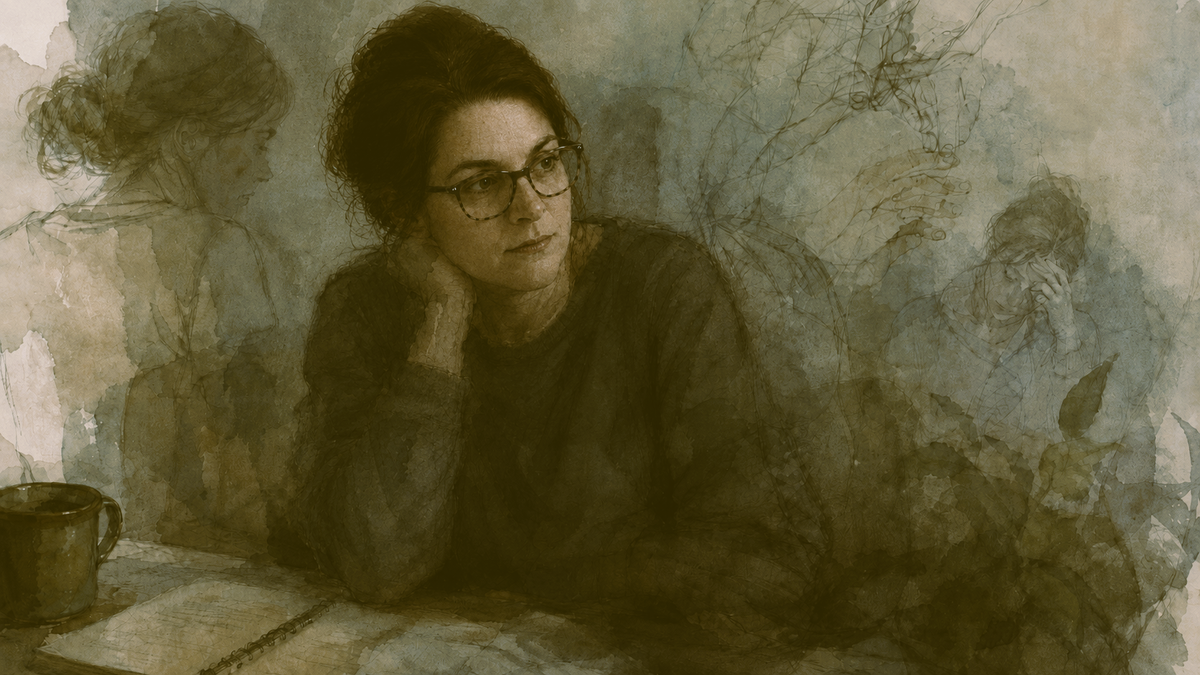
These moments are often quiet, not shaped by a big decision, but by a gradual shift in perspective or feeling. “What Rises in the Stillness“ captures such a moment; a change that happens without being planned or spoken aloud.
What Rises in the Stillness
(a Poem)
By Kerry Ann Wiley
Somewhere—
between the pause
and the reach—
a shift.
Not seen.
Not named.
But felt,
like ash
before flame.
Hands—
they did not meet.
They hovered.
They remembered.
There was no door—
but something opened.
Fire, yes—
but not as destruction.
As a return.
A return
that doesn’t need permission.
Was it a question?
What crossed
didn’t look back.
What stayed
didn’t ask.
Recognizing the Shift Without Defining It
“What Rises in Stillness” does not center on a specific event or a clear decision. It lingers in the space just before or just after something has changed. The focus remains on the moment itself, when a shift becomes evident, even without a clear cause.
The poem resists definition; it moves through the ache of transformation, rising from a silence that hovers just beyond awareness. It is felt more than understood, and it settles into the dark—lingers there, unseen but undeniable.
When Something Opens Without a Sign
The theme captures subtle turning points that pass without design, slipping through the moment almost unseen.
The line “There was no door, but something opened” captures how change can arrive without structure or a signal. Although no step is taken and no boundary is visibly crossed, there is a distinct sense of having something shift into a new and unfamiliar place.
The line about fire—not as destruction. As a return.—suggests that not all change is about ending or erasure. Sometimes, it is a return to something once known, now seen with altered eyes, shaped by distance and touched by time.
It is not the same place, even though it carries the same name. Something that was once overlooked now holds meaning. Something that once felt distant has become unexpectedly intimate. The return is not a restoration; it is a quiet transformation. What was once known is no longer being reclaimed—it is being seen again, changed by time, memory, and perspective.
In the closing lines, the words “What crossed didn’t look back” and “What stayed didn’t ask” point to a change that feels finished without needing to be explained. There’s no tension between what moved on and what stayed behind. Nothing lingers—no reaction, no aftermath. There’s just the simple fact that something shifted. Whatever happened has already settled, as if it had always been that way.
Staying With What Is Unspoken
This piece moves differently than expected. It has no clear beginning, no turning point, and no sense of closure at the end. It stays suspended in a moment already altered—quiet, unspoken, complete.
The change has happened, but nothing declares it. Rather than offering answers, the poem opens a space. It stays close to a feeling almost known—something that rises for a moment, then fades before it can be grasped.
Many moments in life are like this. Something shifts, although it’s hard to say when or why. A thought fades. A feeling drifts. A decision takes shape without ever being spoken. The poem reflects that experience: when something deep stirs, yet asks for neither definition nor a rush to action.
It raises subtle and quiet questions. Can something matter even if it is small or nearly invisible? Can change happen without explanation, without a clear moment when everything shifted?
There are hands that hover but never touch. There is a door that was not there, and yet somehow always was. There is a shadow that moves, though nothing casts it. These are not signs that call out or plead to be understood. They suggest that not all change is loud or visible. Some things shift slowly, without notice. Not everything needs to be seen to be real.
Sometimes a change simply settles in. The question becomes this: how much of a life is shaped by the subtle things—the almosts, the not-quites, the small turns that mark a before and after, even in the absence of witness?
The poem insists that the unspoken matters. A hand not touched still carries meaning. A door unseen can still open. Fire may arrive not as destruction, but as return. The piece speaks to the subtle forces that shape experience—the almosts and not-quites that alter direction without announcement.
In staying with what is uncertain, undefined, and unfinished, the poem gives shape to the shifts and turns that leave no mark, yet alter everything they touch.
Join the conversation. Your thoughts and experiences are welcome.